Getting traffic to your website is only the first step. Turning those visitors into leads and paying customers is another.
Many bloggers, solopreneurs, B2B marketers, and small business owners spend hours creating content, posting on social media, and promoting their services. Yet, they struggle to generate consistent leads or sales. Sometimes, the problem isn’t a lack of traffic. It’s a lack of direction and alignment in marketing efforts with the customer journey.
This is where the pillars of inbound marketing come in.
Inbound marketing is all about providing people with valuable information, building relationships and interactions, and providing a great experience that nurtures customer loyalty. Don’t keep pushing promotional messages; instead, give potential customers something valuable that will get them to discover your business and consider your solutions.
As an example, let’s say your business is a digital marketing blog. Someone searches on Google looking for answers to increase traffic to your website and comes across your SEO Guide.
They download your free keyword research checklist, subscribe to your newsletter, and then they contact you for consultancy services. After receiving good results, they recommend your services to another business owner.
That is inbound marketing in action.
By understanding its three core pillars, you can develop a marketing system that will bring relevant visitors, build trust, and create the opportunity for sustainable business growth.
What is inbound marketing?
Inbound marketing is a strategy that attracts potential customers by providing valuable content, useful resources, and relevant experiences throughout their buying journey.
It helps people discover your business when they are searching for information, comparing solutions, or looking for products and services that meet their needs.
These are typical inbound marketing tactics:
- Search engine optimization (SEO): Helping your website appear in relevant search results.
- Content marketing: Publishing helpful blog posts, guides, videos, and other educational resources.
- Social media marketing: Sharing useful information and building relationships with your audience.
- Email marketing: Sending relevant content and offers to subscribers who have agreed to receive them.
- Lead nurturing: Helping potential customers understand their options through useful communication.
- Customer support: Helping existing customers solve problems and get more value from their purchases.
A practical example of inbound marketing
Suppose you are in the business of web design for small businesses. Your marketing process may look like this:
- You create a blog post on common website design mistakes.
- A business owner discovers it through Google.
- Your free site improvement checklist is downloaded by the visitor.
You send a series of educational emails that explain how to optimize website usability.
The business owner visits your service page and requests a consultation. - They get some useful information and continued support after they become a customer.
Each step gives the potential customer a reason to move forward, but they still do not make an immediate purchase.
It is important that all interactions are useful, relevant, and appropriate to the person’s needs.
What are the three pillars of inbound marketing?
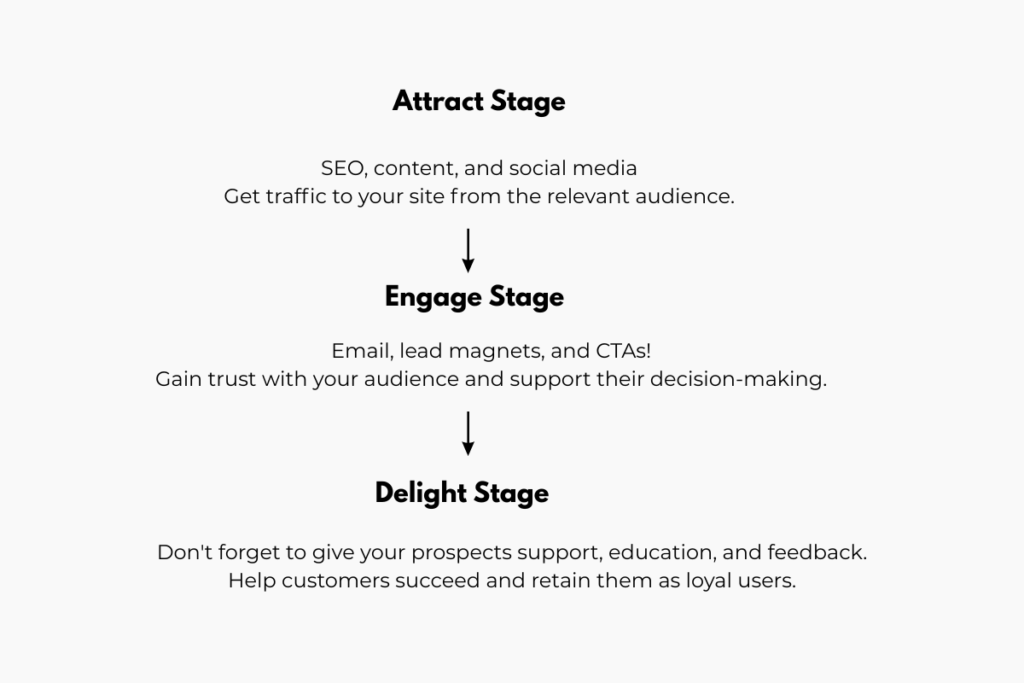
The three main pillars are Attract, Engage, and Delight. These are the aspects of bringing the right people to your business, developing the relationship, and giving them a value-added service after the purchase.
- Attract
Attract relevant visitors to your website through SEO, useful content, social media, and other suitable means.
Objective: Reach the right audience. - Engage
In the engagement stage, you can encourage interested visitors to explore solutions. In this way, you can build trust among them and encourage them to take the next step through email, useful resources, and relevant communication.
Objective: Convert interest to meaningful relationships.
- Delight
Keep providing value via customer education, prompt support, and enabling follow-ups.
Goal: Encourage satisfaction, loyalty, and referrals.
These pillars complement each other. Having visitors to your site but not converting them can be a huge waste of valuable traffic. If prospects are engaged without a good customer experience, it can hurt their trust. Making customers happy, on the other hand, can help to promote repeat business and recommendations.
Let’s take a look at how to use each pillar in your marketing strategy.
1. Attract: Bring the right audience to your website
The first of the three pillars of inbound marketing is to attract people to your content, products, and/or services who are genuinely interested.
It’s not always useful to attract thousands of anonymous visitors. You want people whose needs match the solutions you provide.
For instance, if you own a blog for teaching SEO for beginners, then you could attract visitors who are looking for keyword research tutorials, website optimization tips, and ways to increase organic traffic. Users who are not interested in the information they view will not subscribe or buy relevant services.
A. Use SEO to attract relevant visitors
Optimizing your website for search engines makes it more visible to those looking for information about your business.
If someone is looking for “how to get more traffic to a new blog”, they will have a particular requirement. A helpful article that answers this question can introduce your website to a potential reader or consulting client.
How to use SEO effectively:
- Research relevant keywords. Use Google Keyword Planner, Google Search Console, or Semrush to discover search terms that your audience is looking for.
- Understand search intent. Determine what they need: information, comparison, recommendation, or service.
- Create useful content. Answer the search query clearly and give some real-world examples.
- Optimize the page. Write descriptions for the title, meta description, headings, and the URL.
- Add internal links. Link related articles for visitors to explore further on your website.
- Monitor performance. Review impressions, clicks, organic sessions, and conversions to find opportunities to improve.
For instance, a marketing consultant can write an article about “local SEO tips for small businesses” and “how to make Google Business Profile more visible”. Those who find these guides might get to know about the consultant’s services later.
Focus on search intent instead of keyword stuffing. SEO takes time, so don’t expect immediate results; measure your progress over time.
B. Create content that solves real problems
Content marketing is another important part of attracting an audience.
Before buying a product or service, people often research a problem. You can help them understand their problems, compare solutions, and make informed decisions.
The following are examples of types of content that can be useful:
- How-to guides: Explain how to complete a task step by step.
- Checklists: Help readers follow a process without missing critical information.
- Comparison articles: Explain differences in products, tools, and methods.
- Case studies: Illustrate the case of tackling a problem and the outcomes.
- Tutorial videos: Use tutorial videos for processes that are easier to visualize.
- Templates and worksheets: Provide resources for the reader to use immediately.
Use this content creation process:
- Identify the problem your audience struggles with often.
- Research the questions people ask about that problem.
- Select the most appropriate format of content.
- Provide a solution in clear instructions and examples.
- Add a relevant next step, such as a related article or free resource.
- Update the content when important information changes.
For example, don’t write a general article about digital marketing, but write a guide on how a beginner blogger can find low-competition keywords and how to use them to plan 10 articles for your blog.
Specific, actionable content provides readers with a better reason to visit your website and come back in the future for more advice.
C. Use social media to distribute content
Even publishing a helpful blog post doesn’t mean that your audience will find it. Social media helps you to share content, respond to questions, and reach people who might not be familiar with your website.
Don’t choose platforms to be on everywhere. Decide platforms based on your audience.
- LinkedIn: Share lessons from an SEO project
- Instagram: Carousels, short videos, visual tips. Blogging pitfalls – what are the 5 most common ones?
- Facebook: Community discussions, practical guides: a section on Facebook that allows you to ask questions about small business marketing.
- YouTube: Tutorials and demonstrations: show keyword research step by step
- Pinterest: Share a content planning checklist, infographics, visual guides.
To get started:
- Choose one or two platforms where your audience is active.
- Create multiple smaller pieces of content from one blog post.
- Answer relevant questions without spamming promotional links.
- Encourage discussion by asking useful, specific questions.
- Track website visits, subscriber growth, and inquiries from each channel.
For instance, a 2000-word SEO guide can be a short video, a LinkedIn post, an Instagram carousel, and a Pinterest infographic.
This is a way to make use of the content you already create.
D. Improve your website experience
Attracting visitors is useful only when they can easily find and understand your content.
If your website is slow, confusing, or difficult to navigate, it may cause visitors to leave before discovering your services or other resources.
To improve your website, you should concentrate on:
- Mobile usability: Make sure the text, menus, and buttons are easy to use on mobile screens.
- Page speed: Compress images, remove unwanted scripts, and use appropriate caching.
- Clear navigation: Organize posts into meaningful categories.
- Focus on readability: Avoid using long paragraphs, tables, and headings.
- Trust signals: Provide relevant policies, author info, and contact details.
- Accessibility: Use appropriate contrast, alternative text for meaningful images, and descriptive links.
Look at main pages on desktop and mobile devices. Ask whether a first-time visitor can understand your website, find relevant information, and identify the next step without confusion.
E. Match content to the buyer’s journey
Not every visitor is ready to buy. Some people are learning about a problem, while others are comparing solutions or deciding which provider to choose.
Create content for different stages of awareness.
Review your existing content and identify which stages it covers. If you have a lot of introductory pages but few comparison pages, service pages, or practical next steps, you may attract more people to show up on your website without helping them take action.
The attraction pillar works best when the right people find the right information at the right time.
2. Engage: Turn interested visitors into leads and customers
Attracting relevant visitors is only the beginning. The second of the inbound marketing pillars is about building relationships with those visitors and helping them move toward an appropriate solution.
Engagement is not sending a lot of sales messages. This is about knowing what users want and giving them information that is useful to them when making a choice.
A. Use lead magnets to build your email list
A lead magnet is a free resource that’s given in return for a visitor’s contact details, usually an email address.
Examples include:
- An SEO checklist for beginner bloggers.
- A content calendar template for small businesses.
- A keyword research worksheet.
- A website audit checklist.
- A short email course about improving organic traffic.
How to create a good lead magnet:
- Identify the problem your audience faces and give them a solution.
- Develop a resource offering a practical solution.
- Build a simple landing page in which you can explain the benefits of Inbound marketing.
- Include a sign-up form asking for critical details only.
- Provide the resource after signing up.
- Send supportive emails related to the resource.
If you write a keyword research guide, end it with a free keyword planning worksheet, for instance. If someone downloads it, they have already shown interest in SEO, making future communication more relevant.
Be specific about the offer. “Download My Free Keyword Research Worksheet” works better than “Subscribe to My Newsletter.”
B. Use email marketing to build trust
When it comes to email marketing, you can reach the people who want to hear from you. It can help you share new content, answer common questions, and introduce relevant products or services.
The idea is to give value, rather than make every email a sales pitch.
Below is a basic welcome email sequence that you can adapt:
- Welcome email: Send it ASAP and deliver the promised resource.
- Educational email: Explain a related problem and make the readers understand it.
- Practical email: Give an example or a step-by-step tutorial that may be useful.
- Recommendation email: Recommend a tool or resource that is relevant.
- Action email: Ask readers to take a next step.
Adjust this schedule to suit your audience. If five emails are not necessary, don’t send.
To improve engagement:
- Make clear subject lines.
- Use a familiar and “friendly” tone.
- Send content relevant to subscribers’ interests.
- Add an appropriate call to action.
- Make unsubscribing easy.
- Get the appropriate consent and follow privacy laws.
Don’t purchase email lists or send out spam. These practices can cause lost trust and email deliverability issues.
C. Personalize communication
Personalization is about making your communication relevant to a person’s interest, need, or stage in the buying process.
No costly marketing software is needed.
For example:
- Those who download an SEO checklist will receive SEO tutorials.
- If readers are interested in affiliate marketing, they will receive product comparison guides.
- When prospects request a consultation, they are provided with relevant service information.
- Resources related to their projects are provided to existing clients.
The first thing to do is to categorize subscribers into groups based on what resources they want or what topics they select. Then send information that fits those interests.
Analyze email clicks, responses, conversions, and unsubscribe rates to gauge the effectiveness of your messages. Collect only the information you genuinely need.
D. Create clear calls to action
A call to action (CTA) directs visitors on what to do next.
Without a clear next step, readers might finish an article and never enjoy your resources or services.
Useful CTAs include:
- Download the free checklist.
- Read the related SEO guide.
- Subscribe for weekly blogging tips.
- Compare the recommended tools.
- Request a consultation.
- View a relevant case study.
Here are some steps you can take to make your CTAs better:
- Match the CTA with the page’s topic.
- Discuss the benefit of making a choice.
- Be direct and descriptive in your language.
- Place it naturally where helpful information is found.
- Simplify the destination for mobile and desktop users.
- Monitor clicks and valuable conversions.
For example, an introductory article on email marketing might give a checklist to download for people who are just getting started with email marketing, instead of an upfront sales pitch for an expensive service.
Use marketing tool comparison pages to pitch products or invite readers to book a consultation.
E. Build trust with evidence
Trust has an impact on whether or not potential customers feel comfortable making a choice for your business.
It can be built by:
Providing correct and well-researched information.
- Explaining the reasons for recommending a specific solution.
- Sharing genuine testimonials with permission.
- Publishing and sharing case studies about relevant topics.
- Disclosing affiliate relationships.
- Providing honest responses to frequently asked questions.
- Giving clear explanations of products and services, and their cost.
For instance, a digital marketing consultant may write a case study about the work performed for a client, the measurement period, and the outcomes that were achieved. The information should be accurate and should not overestimate the consultant’s role.
These activities help make the engagement stage more effective because individuals can assess your competence before making a decision.
3. Delight: Turn customers into loyal supporters
The third of the pillars of inbound marketing focuses on what happens after someone becomes a customer.
There are many businesses that spend a lot of money on acquiring new customers, but pay less attention to existing ones. However, if the customer experience is good, they will return and refer others if helpful support and useful follow-ups are provided.
Delighting customers means going the extra mile after the sale to continue to add value to the customer.
A. Provide excellent customer support
Customers might need help to understand a product or use a service, or to solve a problem. Helpful support makes it easier for them to get the results they expected.
Small businesses can improve support without hiring a large team.
- Set clear expectations: Explain your work schedule and availability.
- Make help accessible: Provide contact information, frequently asked questions, and pertinent documentation.
- Give practical answers: Do not provide a generic response, but solve the customer’s actual problem.
- Follow up as needed: See if that solved the problem.
- Improve your resources: Turn recurring questions into informative tutorials.
For instance, if clients are often asking you how to interpret the data from their website, make a guide on impressions, clicks, sessions, and conversions.
This allows customers to feel more confident and reduces repetition of support requests.
B. Educate customers after a purchase
Customer education enables individuals to make the most of what they buy.
A website design client may need maintenance instructions. An SEO client may need help understanding performance reports. A software customer may benefit from a video tutorial.
Send a welcome e-mail providing the next steps, a link to relevant resources, and include contact details.
Follow-up resources can also be sent based on the services purchased. The aim is to help customers achieve the outcome they originally wanted.
C. Collect feedback and improve
Customer feedback can reveal problems that you might otherwise overlook.
You can collect it through:
- Short email surveys.
- Follow-up conversations.
- Customer interviews.
- Website feedback forms.
- Honest reviews.
- Support request analysis.
Use a simple process:
- Ask specific questions about the customer’s experience.
- Make responding easy.
- Identify recurring concerns.
- Prioritize improvements that address important problems.
- Let customers know when their feedback leads to a change.
For instance, if several clients find your monthly reports confusing, add a summary explaining the main results and recommended next steps.
Collecting feedback is useful only when you use it to improve the customer experience.
D. Encourage reviews and referrals
Satisfied customers can recommend your business, but they don’t always remember to do so. A polite request after a successful project can encourage them to share their experience.
You can also:
- Share helpful resources with existing customers.
- Offer relevant follow-up services when they genuinely need them.
- Create a simple referral process.
- Send occasional updates that provide value.
- Ask for honest reviews without pressuring customers.
For example, after completing an SEO project, you could provide a final report, explain recommended next steps, and ask whether the client would be comfortable sharing an honest review.
Avoid pressuring customers to leave positive reviews or using incentives that violate review platform policies.
E. Create a helpful customer community
I have seen many businesses implementing a very useful strategy. They provide a space for customers to exchange their thoughts and ask questions.
It can be a private group discussion, a customer newsletter, a webinar series, or a resource library, depending on your audience.
For example, a blogger offering content strategy templates could launch a monthly webinar to discuss the challenges that customers face and how they can boost their content approach.
Start with the format that you’ll be able to maintain throughout. It is better to have a useful monthly workshop than a large community that receives little attention.
How the three pillars of inbound marketing work together
The 3 pillars are interlinked in the customer journey. Each stage supports the next.
Feedback from customers can lead to better marketing activities.
Happy customers will come back, refer you, and help drive new leads.
Suppose that you have a digital marketing blog offering consulting services.
- Attract: You publish an SEO guide that brings visitors from Google.
- Engage: You provide a free keyword research template and send subscribers helpful emails.
- Delight: A subscriber becomes a client and receives useful reports and support.
- Grow: A delighted customer recommends your services to other business owners.
Not all visitors will follow this exact path, and the time required to convert a prospect will vary. But if you apply these activities, this gives your marketing a clearer purpose.
How to measure inbound marketing success
You can track and understand the relevant metrics and gauge whether your marketing is attracting the right audiences, creating leads, and helping you to maintain customer relationships.
Don’t base your success on traffic. It may be more beneficial to have a smaller audience that generates relevant inquiries than a large audience with little interest in your services.
Set simple and measurable goals that are in line with where you are starting. For example, your aim can be to publish four useful articles, a higher click-through rate of an important search result, or more qualified consultation inquiries.
If a page is being viewed by visitors but not many of them are clicking, look at the title, description, and search intent. If it attracts visitors but generates few signups, you might want to reassess your lead magnet based on the needs of your readers.
Check the results on a regular basis, giving time for longer-term activities like SEO to have a measurable impact.
Frequently asked questions
1. What are the three pillars of inbound marketing?
Attract, Engage, and Delight are the three pillars. Attract gets the right people to your business, Engage connects with those prospects and influences their decision, and Delight makes sure your customers have a positive experience that will lead to loyalty.
2. What are the four stages of inbound marketing?
A common four-step process includes Attract, Convert, Close, and Delight.
- Convert – To convert visitors into leads.
- Close – To turn qualified leads into customers.
These stages are in addition to broader Attract, Engage, and Delight practices.
3. Is SEO part of inbound marketing?
Yes. SEO helps people find relevant content through search engines. Keyword research, valuable content, technical accessibility, and website experience can all enhance visibility and aid in lead generation.
4. Can small businesses use inbound marketing with a limited budget?
Yes. Small businesses can create a website, good content, simple analytics, an email follow-up form, and a simple follow-up process. Use of free tools can help with research and measurement. Knowing the target market and delivering value is more important than purchasing costly software.
5. How long does inbound marketing take to work?
The time frame will vary based on channel, competition, and starting point. Email campaigns and existing audiences can deliver results quicker than SEO, and email marketing can deliver results over the course of months. Repeat purchases and referrals are possible means of measuring the effectiveness of customer retention activities.
Final Go Through
The pillars of inbound marketing provide a practical framework for attracting relevant audiences, building meaningful relationships, and creating better customer experiences.
Attract draws individuals to your business through useful content and relevant channels. Engage builds interest, trust, and informed decisions. Delight: Customers continue to receive value after their purchase.
You don’t have to use all the tactics. First, understand your audience, then create content to address a real problem, provide something helpful next, and enhance your customer support.
Track your progress, listen to the feedback, and concentrate on what activities are helping you meet your business objectives. It’s more important to make consistent improvements rather than to follow every new trend in marketing.
Your next step: Choose one pillar to improve this week. Publish a helpful blog post, create your first email signup offer, or improve your customer onboarding process.
Which of the three pillars is your biggest priority right now: Attract, Engage, or Delight? Leave comments below and sign up for the newsletter for more digital marketing and blogging tactics.