
In today’s online world, every business needs digital marketing. From reaching the right audience to building brand awareness and driving sales, digital marketing offers powerful tools to connect with customers where they spend most of their time online. In this blog, we’ll explore the key strategies, tips, and techniques that can help beginners, business owners, and marketers harness the full potential of digital marketing to grow their brand and achieve measurable results.
Digital marketing is how businesses reach people online and show them what they offer. It helps attract customers, build a brand, and grow sales. In this blog, we will explain easy and useful tips for anyone who wants to understand and use digital marketing effectively.
Why Digital Marketing Matters
The importance of digital marketing may be attributed to the following reasons:
- Nowadays, people spend hours daily on the internet and explore different digital channels for their needs.
- Online platforms allow you to target your specific audience more precisely.
- Digital marketing is more affordable and measurable than traditional advertising.
- It allows both small and large businesses to compete fairly.
Digital marketing enables businesses to grow in the online world by directly connecting them with potential customers.
Digital Marketing vs Traditional Marketing
Digital marketing combines creativity, strategy, and technology. It includes multiple methods to promote and sell through the internet.
Here’s how it differs from traditional marketing:
| Aspect | Traditional Marketing | Digital Marketing |
|---|---|---|
| Medium | TV, radio, print, billboards | Websites, social media, email, search engines |
| Targeting | Broad audience | Specific and segmented targeting |
| Cost | High and fixed | Flexible and cost-effective |
| Measurement | Hard to track | Real-time analytics |
| Engagement | One-way communication | Two-way interaction with customers |
In short, digital marketing is marketing done through various digital channels like websites, search engines, email, and social media, where your audience spends most of their time.
The Core Components of Digital Marketing
Digital marketing is not one single strategy; it’s a combination of several techniques working together. Let’s understand the main components:
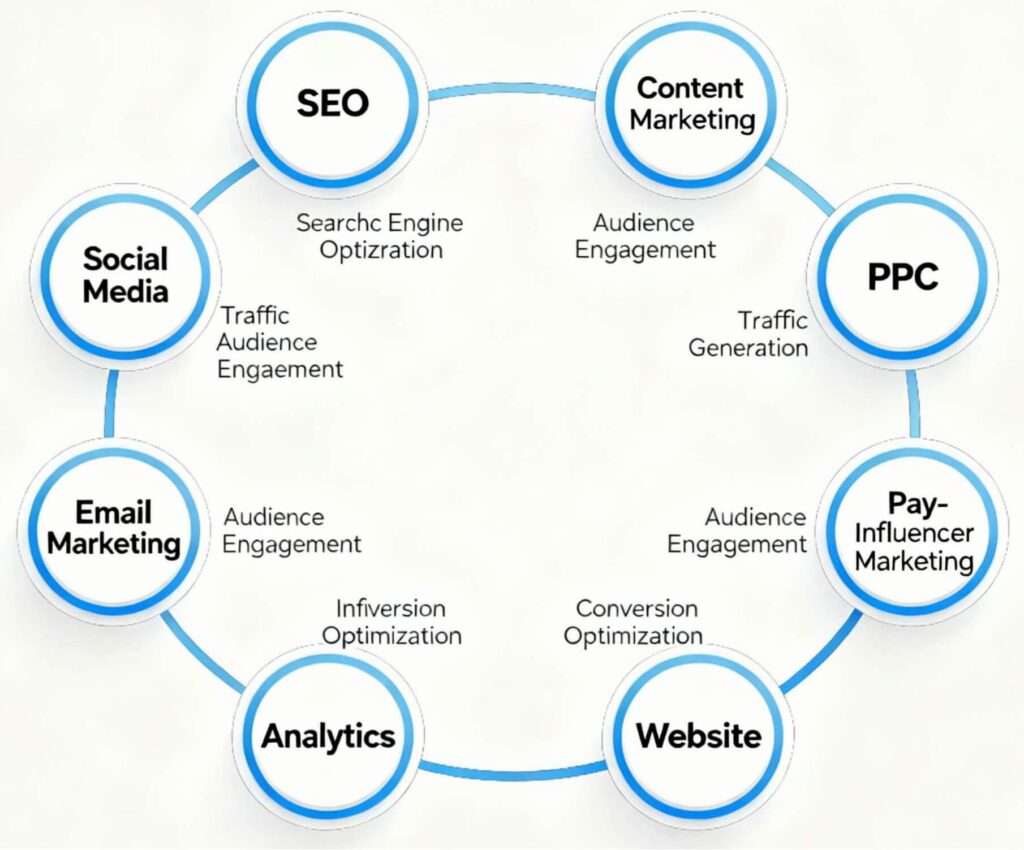
1. Search Engine Optimization
SEO is the process of optimizing your website to appear higher on search engine results pages (SERPs). It helps increase your site’s visibility when people search for related products or services.
The key elements of search engine optimization or SEO include:
- Keyword research.
- On-page optimization like meta title, meta description, URL, and content.
- Technical SEO (site speed, mobile optimization).
- Off-page optimization, which involves getting Backlinks from trusted websites.
The Goal of search engine optimization is to get organic (free) traffic from search engines like Google and Bing.
2. Content Marketing
Content is the heart of digital marketing. By content marketing, we mean creating valuable, relevant, and consistent content to attract and engage your target audience.
The various types of content that are used in digital marketing are:
- Blog articles– Writing articles that provide useful information to the readers. For details on blog content writing, you can read our article on content writing tips for beginners.
- Infographics– An infographic is the representation of any information or data in the form of visuals. A good infographic is more valuable than thousands of words.
- Video content-The information provided in the form of videos comes under video content. It can include short video clips normally used for social media, or it can be longer content like tutorials, vlogs, and webinars.
- eBooks and Guides– Used for education, business, and personal reading. They are very convenient, accessible, and interactive formats for information.
- Case studies– Case studies help us deeply understand a specific topic by analyzing it in a real-world context.
One basic rule of content marketing is that you should never sell your content. Instead, make them learn about you. People love learning. The major aspect of Content marketing is to build trust and authority by helping your audience before you sell to them.
3. Social Media Marketing
Social media platforms are powerful tools to promote your business and build a community. Use these platforms to create brand awareness, drive sales, and increase website traffic by creating engaging content, running targeted ads, and interacting with customers.
These platforms include:
- Facebook– Facebook helps people stay in touch with friends and family, share photos, videos, and updates, and find entertainment or news. It’s also used by businesses to promote their products and connect with customers. It is also used by people to join groups with similar interests.
- Instagram– Just like Facebook, Instagram is also a social media platform where people share photos and videos with friends, family, or the public. Users can like, comment, and follow others, while businesses use it to promote their products and build their brand.
- LinkedIn– LinkedIn is a platform for professional networking, career growth, and business connections. People use it to find jobs, build relationships, showcase their skills, and learn new ones. Businesses use it to hire talent, promote their brand, and connect with customers.
- Twitter (X)– Twitter is mainly used to share information in real time, stay updated on news, connect with people, and join public conversations.
- Pinterest– Pinterest is a visual platform where people find, save, and share ideas through images and videos called “Pins.” Businesses also use it to attract audiences looking for inspiration and to drive traffic and sales.
- YouTube– YouTube is a platform for watching and sharing videos, including entertainment, tutorials, vlogs, music, and documentaries.
The primary goal of social media marketing is to increase brand awareness, drive traffic to your website/blog, generate leads and sales, and build long-term relationships with your audience.
Stay consistent and use visuals, videos, and stories to engage better.
4. Pay-Per-Click Advertising (PPC)
In PPC advertising, you pay each time someone clicks on your ad. It provides quick visibility and measurable results.
The most used PPC platforms are:
- Google Ads– Google Ads helps businesses promote their products or services by showing ads on Google Search, YouTube, and partner websites. It’s used to boost sales, get leads, drive website traffic, and build brand awareness.
- Bing Ads– Bing Ads, now called Microsoft Advertising, is used to create and manage pay-per-click (PPC) ads on search engines like Bing, Yahoo, and DuckDuckGo, as well as on other websites and apps.
- Facebook Ads– Facebook ads help businesses promote their products or services to specific audiences on Facebook and Instagram. They’re used to increase brand awareness, attract leads, and boost sales through targeted campaigns.
- Instagram Ads– Instagram ads are paid posts that help businesses reach more people and promote their products or services.
- LinkedIn Ads– LinkedIn Ads help businesses reach professionals to meet goals like getting leads, building brand awareness, driving website traffic, and hiring talent. They let businesses target people by job title, industry, or company size, making them useful for B2B marketing.
The ultimate purpose of PPC Ads is to get instant traffic, a highly targeted audience, measurable ROI, and budget flexibility.
5. Email Marketing
ChatGPT said:
Benefits of email marketing include:
- Personalized communication.
- High ROI (Return on Investment).
- Automation possibilities.
- Easy tracking of open and click rates.
It is advisable to segment your audience and send relevant content, not generic newsletters.
6. Affiliate Marketing
Affiliate marketing allows businesses to partner with affiliates (bloggers, influencers, or publishers) who promote their products for a commission on sales.
How it works:
- You share a special link called affiliate link on your website page/blog.
- When someone buys a product or service using that link, the affiliate earns a percentage of that sale.
Affiliate marketing is for businesses to expand reach without heavy advertising costs.
7. Influencer Marketing
In this type of marketing, social media personalities called influencers with large followings promote a brand. It builds trust because people follow influencers they admire. Influencers leverage their credibility in a specific niche, creating authentic content like reviews and tutorials to engage their audience and influence purchasing decisions. They act as a bridge between brands and consumers.
Influencers can be categorized into following types:
- Mega Influencers– Eminent personalities like celebrities.
- Macro Influencers– Having 100k+ followers.
- Micro Influencers– With 10k-100k followers.
- Nano Influencers– 1k-10k followers.
For smaller brands, micro and nano influencers are suitable options as they are more cost-effective. Collaborating with them can bring excellent ROI.
8. Marketing Automation
Marketing automation leverages technology to automate repetitive tasks, save time, and deliver a more personalized experience for customers. Software tools are used to manage tasks, like sending emails, segmenting leads, or scheduling posts.
A few of the tools used for automation are:
- HubSpot– HubSpot helps automate and manage marketing tasks to boost efficiency and business growth. It lets businesses create personalized campaigns, nurture leads, and manage customer relationships easily. Its main features include automating emails based on user actions, organizing audiences into segments, and tracking performance with detailed analytics..
- Mailchimp– Mailchimp automation helps simplify marketing tasks and improve customer engagement by automatically sending personalized emails and messages at the right time.
- Active Campaigns– ActiveCampaign automation helps save time by automatically managing marketing and sales tasks like sending emails, nurturing leads, and personalizing customer experiences.
- Zapier– Zapier helps automate tasks by creating “Zaps” that move data between different apps. This saves time, reduces manual errors, and helps gather insights from various marketing tools.
The benefit of marketing automation is that it saves time and ensures a consistent marketing flow.
How Digital Marketing Works
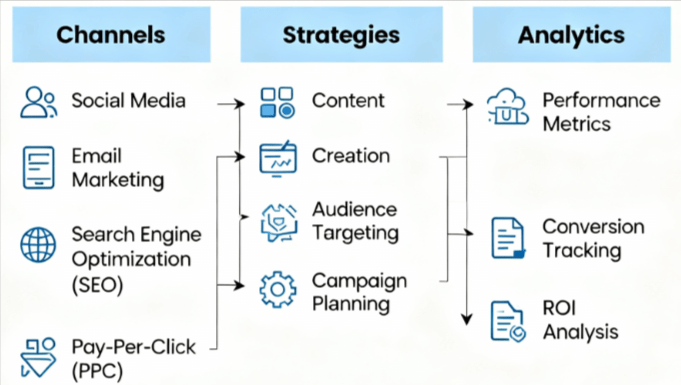
Key points to be followed in digital marketing are:
- Identify Your Target Audience– Categorize your audience according to your niche. Define demographics: their age, gender, location, and interests. Identify their pain point.
- Set a Clear Goal– Decide what your goal is: building brand awareness, getting leads, increasing website traffic, or boosting sales.
- Choose Digital Channels/Platforms– Choose the platforms that fit your audience, like SEO, social media, email, or paid ads.
- Create Valuable Content– Develop Unique content that educates, informs, or entertains your audience.
- Promote Your Content– Share the content on multiple platforms to get maximum reach.
- Measure and Optimize– Track performance with analytics tools and improve campaigns based on results.
Benefits of Digital Marketing
Digital marketing helps businesses reach a wider audience at a lower cost compared to traditional marketing. It allows precise targeting, so you can connect with the right people based on their interests, location, or behavior. It also provides real-time data to measure performance, improve campaigns, and boost sales. Most importantly, it helps build stronger customer relationships through personalized and consistent communication.
The key benefits are:
- Cost-Effective-Lower cost compared to traditional advertising.
- Global reach– You can connect with customers worldwide.
- Measurable Results– With tools like Google Analytics, you can check what’s working.
- Targeted Audience– You can reach the right people with precision.
- High Engagement– Interacting with the audience makes two-way communication and builds relationships.
- Better Conversion Rate– Campaigns can be made more personalized and data-driven.
Creating a Digital Marketing Strategy
Using the right channels and methods, a well-planned digital marketing strategy can help achieve your business goals. Creating a digital marketing strategy involves setting clear goals, understanding your audience, and choosing the right online channels to reach them. It includes planning content, selecting platforms like social media, email, or search engines, and setting a budget for ads or promotions.
A good strategy also tracks performance through analytics to see what works and make improvements. This approach helps businesses stay focused, save time, and achieve better results.
Steps to Build a Strategy
- Define Goal– Your goal should be specific, Measurable, Achievable, Relevant, and Time-bound.
- Analyze Target Market– Thoroughly analyze your target audience relevant to your niche.
- Study Competitors– Do a competitor analysis to check what strategy they are following.
- Choose Digital Channels– Sharing your content on digital platforms is vital for the organic growth of your content.
- Set a Budget– Define a daily budget for campaigns. Keep tracking ROI.
- Content Calendar– Plan your content posting schedule.
- Measure and Optimize– Use analytics tools to check insights.
Key Points for Balanced Strategy
- Use SEO and content marketing for long-term growth.
- Run PPC ads occasionally for quick results.
- Be active and engage on social media for brand visibility.
- Use email marketing to nurture leads.
Measuring Digital Marketing Performance
Measuring digital marketing performance is essential to understand what’s working and what’s not. It helps businesses track key metrics like traffic, leads, and conversions, so they can make data-driven decisions. By analyzing performance, marketers can optimize campaigns, use budgets more effectively, and improve overall results.
Important Metrics can be categorized as:
- Website traffic.
- Click-through rate (CTR).
- Conversion rate.
- Cost per lead (CPL).
- Return on Ad Spend (ROAS).
- Customer life time value.
Top Tracking Tools
- Google Analytics.
- Facebook Ad manager.
- Hubspot.
- SEMrush
Track these metrics and regularly optimize your content for the best results.
Essential Tools for Digital Marketing
To maximize organic reach and make your campaigns effective, use the right tools:
| Purpose | Tools |
|---|---|
| Keyword Research | Google Keyword Planner, Ahrefs, SEMrush |
| Analytics | Google Analytics, Hotjar |
| SEO | Yoast SEO, Rank Math |
| Email Marketing | Mailchimp, ConvertKit |
| Social Media | Buffer, Hootsuite |
| Design | Canva, Adobe Express |
| Automation | HubSpot, Zapier |
These tools help save time, manage campaigns, and analyze performance accurately.
Common Mistakes to Avoid
Common digital marketing mistakes include not having clear goals, ignoring your target audience, and failing to track results. Many businesses make these mistakes and focus only on selling instead of building relationships or providing value. Inconsistent posting, poor content quality, and neglecting SEO are other frequent issues.
Avoiding these mistakes helps improve your marketing efforts, strengthen your brand, and achieve better results over time.
- Ignoring mobile optimization.
- Not tracking campaign performance.
- Focusing only on selling, not educating.
- Using outdated SEO practices.
- Not consistently posting content on digital platforms.
Avoiding these mistakes can help you get better results.
How Small Businesses Can Benefit
Latest Trends in Digital Marketing
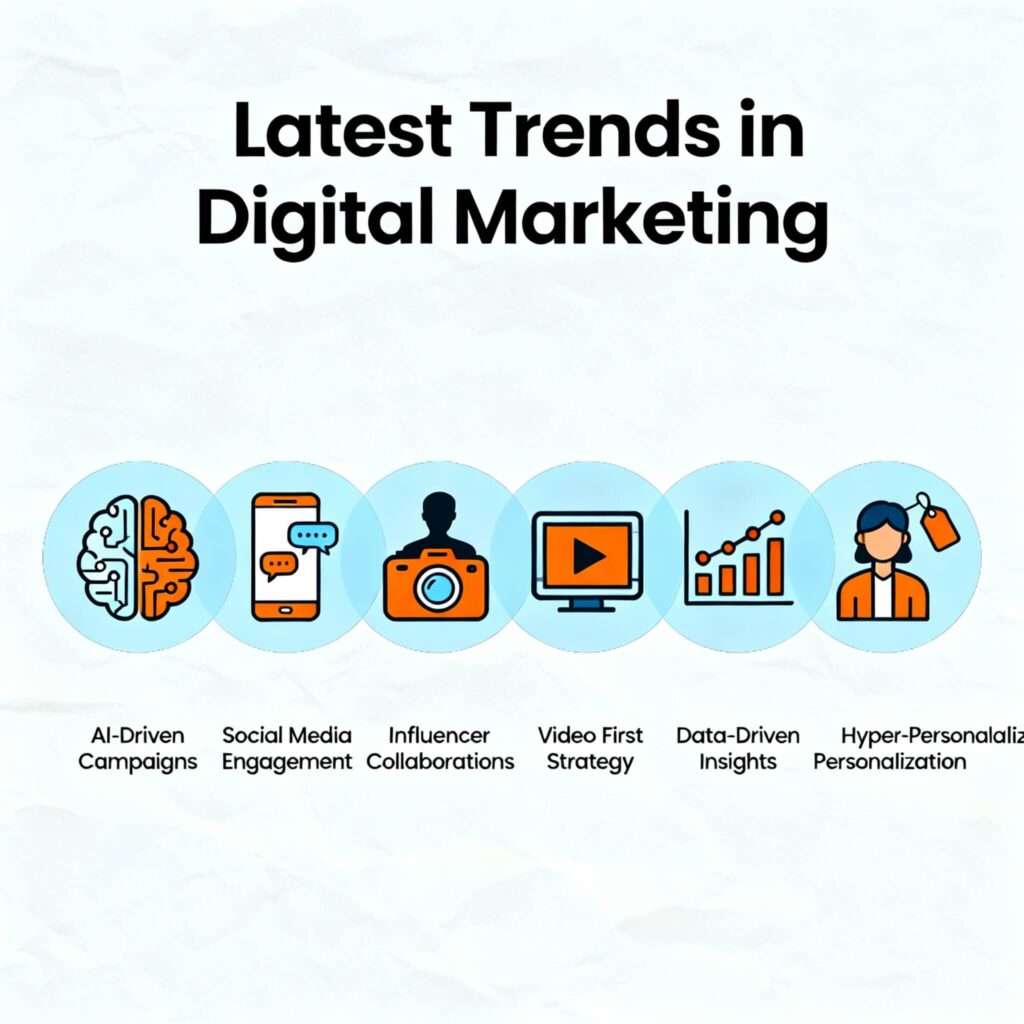
The latest trends in digital marketing focus on personalization, AI-driven content, and short-form video. Brands are using tools like chatbots and automation to improve customer experiences and save time. Influencer marketing and user-generated content are growing as people trust real voices more than ads.
- AI and Automation– In content creation and customer support. Chatbots are replacing humans. AI is extensively being used for content writing.
- Voice Search Optimization– Smart devices have the option of voice search instead of typing a query manually.
- Video Marketing– AI is being used for long video marketing and also short-form video content.
- Personalization– User data is analyzed and behavior is tracked.
- Interactive Content– User is engaged with polls, quizzes, and AR filters.
- Sustainability Marketing– Used to attract eco-conscious consumers.
It is essential to keep updated with digital marketing trends to stay ahead of your competitors.
Future of Digital Marketing
The future of digital marketing will be driven by artificial intelligence, automation, and data personalization. Marketing will become more predictive, using AI to understand customer behavior and deliver tailored content in real time. Video and voice search will continue to grow, while privacy and ethical data use will become even more important. Businesses that adapt to these changes and focus on authentic, personalized engagement will stay ahead in the digital landscape.
Let’s see what we can expect:
- AI-driven content creation and chatbots.
- Virtual and augmented reality in ads.
- Advanced data privacy and transparency.
- Predictive analytics for smarter targeting.
- Bringing all marketing channels together to create a unified customer experience.
Marketers will have to adopt the latest trends to lead the digital revolution.
Conclusion
Digital marketing is the bridge between businesses and their online audience. It is the backbone of modern business growth, and learning it today prepares you for tomorrow’s digital world. Whether you are a beginner learning the basics or a business owner aiming for growth, mastering digital marketing opens endless opportunities.
Start small, learn consistently, experiment with different channels, and use data to guide your decisions. Remember, success in digital marketing comes from understanding your audience and providing real value.